Geopolitical risk monitoring: a method and the software to track your exposure
Updated
For a company, geopolitical risk is the chance that a political, military or diplomatic event reaches its operations: a conflict near a site, sanctions against a supplier’s country, tension in a strait on a supply route, a spike in energy prices. Monitoring it is less about following world news than about connecting each event to what you own, buy and sell. It runs in five steps: map your exposure, choose the risks and the sources, monitor and qualify the signals, quantify the impact, then decide and prepare your responses. Geopolitical risk monitoring software mostly automates collection, matching events to your assets, and alerts; the trade-offs remain leadership’s call. InekIA places your sites, suppliers, customers and routes on a globe, matches them against conflicts, disasters, sanctions and tension in key straits, alerts you when one of them is exposed, and lets you quantify a shock before you decide.
What geopolitical risk covers for a company
Geopolitical risk is nothing abstract for a company: it is the share of its business that depends on countries, routes and political decisions it does not control. It shows up in six families of facts.
- Conflict and political violence
- Wars, armed clashes, attacks, protests and riots near a site, a supplier or a customer.
- Sanctions and controls
- Restrictive measures, asset freezes, export controls: they can rule out a business relationship or a payment overnight.
- Political stability and institutions
- A change of government, a coup, a weakening rule of law, corruption: all of them change the conditions for doing business in a country.
- Routes and straits
- Tension in a strait or a canal lengthens lead times and raises freight costs on every route that runs through it.
- Energy and commodities
- Geopolitical crises pass quickly into the prices of energy and critical materials, and from there into your production costs.
- Trade and tariffs
- New tariffs, quotas, rules of origin: they can change a supplier’s or a market’s competitiveness overnight.
What it is not
- Country risk alone
- A country rating tells you whether the environment is fragile in general. A company’s geopolitical risk depends on what it has in that country and on the routes that run through it.
- A forecast
- No one reliably predicts a conflict or a sanction. The aim is to see early, to know what would be hit and to have a response ready.
- A job for specialists only
- It concerns procurement, finance, the supply chain and the executive team. Analysis that never reaches operations stays theoretical.
Monitoring geopolitical risk in five steps
Many set-ups lose steam for the same reason: they follow the world instead of following their own exposure. The method below starts from what the company owns and depends on, then works back to the events.
- 01
Map your exposure
List your sites, critical suppliers, major customers and the routes that connect them. For each one, record the country, the location and what would happen if it stopped for a month. That map is the starting point for everything else: an event only matters if it reaches one of those points.
- 02
Choose the risks and the sources
Keep the risk families that really weigh on your map: a company sourcing from Asia will follow straits and tariffs first; a group present in fragile countries, political stability and sanctions. Combine the news (international and local press, institutions, regulators), official data (sanctions lists, governance indicators) and geolocated events (conflicts, and natural disasters, which hit the same sites and routes).
- 03
Monitor and qualify the signals
Match each event against your map: near which site, on which route, at which supplier. Always keep the dated, sourced fact apart from its interpretation. Follow the chains of events too: a strike on an energy facility can push prices up, then trigger retaliation that reaches another country on your map.
- 04
Quantify the impact
Exposure only becomes a board topic once it has an order of magnitude. Describe the shock, start from your own figures (the share of the affected item in your costs, revenue at risk, margin) and compare several scenarios, from contained to severe, rather than a single one.
- 05
Decide, prepare responses, review
For each major risk, agree in advance on the possible responses (safety stock, a second supplier, another route, hedging) and on the threshold that triggers them. Record the owner and the deadline, then come back to it as the situation changes: a decision nobody follows up protects no one.
How often?
Three rhythms work together: alerts, when an event directly reaches a site or a route; a regular review of the whole map; and a periodic review that updates the map, the scenarios and the trigger thresholds.
How InekIA supports each step
InekIA is a strategic intelligence platform. For geopolitical risk, it connects world events to your assets, quantifies shocks from your own data and keeps a record of decisions. The call stays yours.
Your assets on the globe
In the Strategic View, you place your sites, suppliers, customers and warehouses on the globe. InekIA derives your supply and delivery routes from them, by sea or by land, and each sea route shows the straits it crosses.
What gets published and what gets measured
Vigia watches more than 500 feeds (press, institutions, regulators, social media and forums) and matches every new article against your scope within half an hour. The globe adds event layers: conflicts, natural disasters, energy infrastructure, straits. For each country, a panel brings together public governance indicators, such as political stability and the rule of law, and the sanctions regimes that concern it.
An alert when you are exposed
When an event occurs within the radius of one of your sites, you are alerted; routes that cross an area under tension are flagged as exposed. On the monitoring side, each signal gets a 0 to 10 score based on your role, sector and topics, and alerts keep the sourced fact apart from the reading by Kairos, the analysis engine. The geopolitical graph in Vigia shows what causes, worsens or responds to what.
A shock quantified before you decide
With Simulation, you describe a shock (a gas price rise, a closed strait, new tariffs) and enter your figures. Kairos produces three scenarios, contained, central and severe, with the impact on your costs, revenue and margin, the agent committee’s view and countermeasures with their trigger thresholds. Every calculation is recomputed and checked. When a supplier is hit, the One-Click supplier risk template sets out the exposure, the scenarios and the 30-day options; for a more open question, Analyze brings together six agents, one of them dedicated to risk.
Responses decided and followed through
The Strategic View matrix ranks your topics by urgency and impact: act now, schedule, monitor or delegate. A decision you keep becomes a Stratebox card, with its owner, deadline and sources. Reports turns it into an executive summary for the committee, with citations checked, exported as PDF.
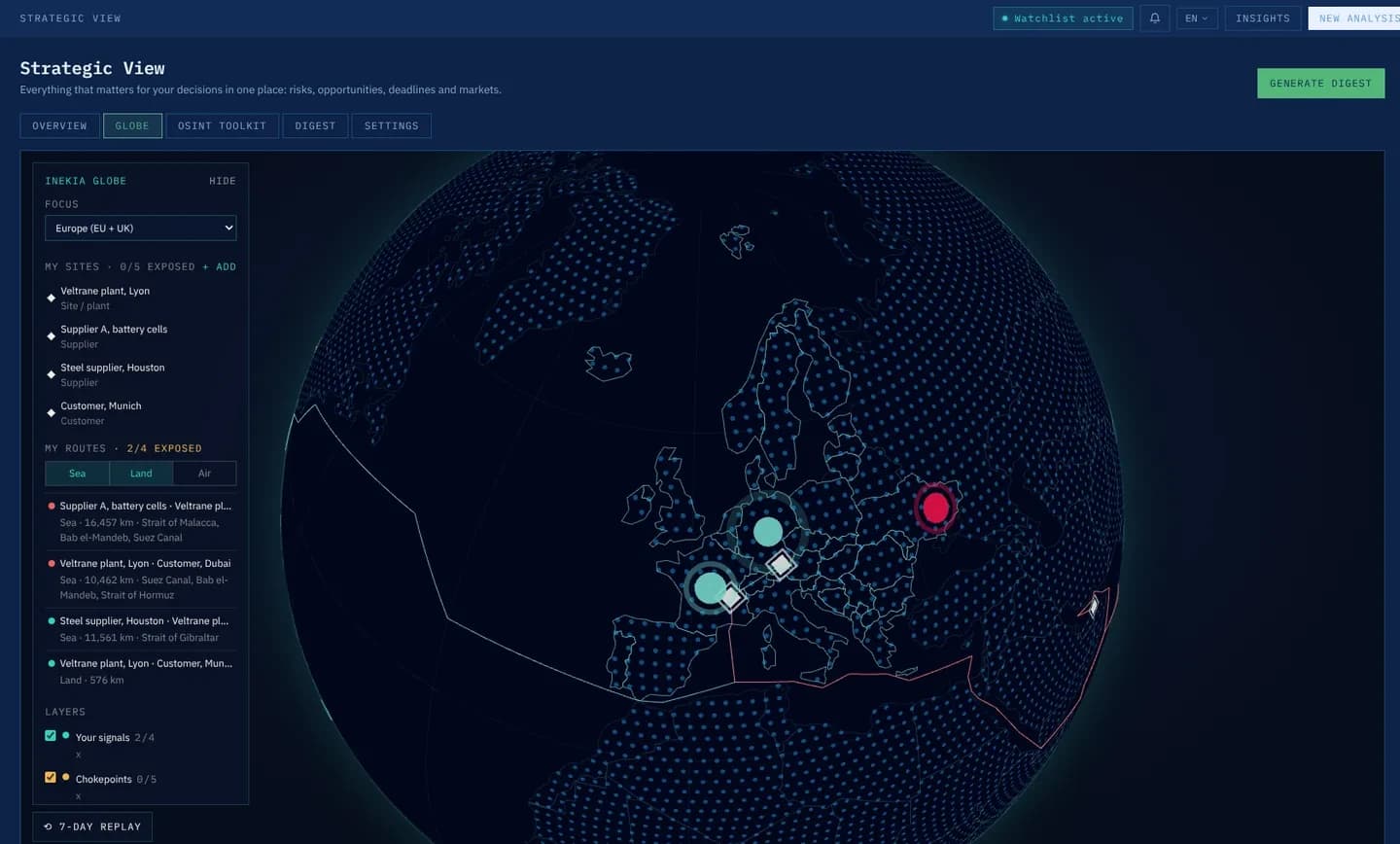
In this screenshot of the app, a fictional company has placed its plant, suppliers and customers on the globe. Its sea routes run through the Strait of Malacca, Bab el-Mandeb, the Suez Canal, the Strait of Hormuz or the Strait of Gibraltar: two routes out of four are flagged as exposed. The “your signals” and “chokepoints” layers are on, and the 7-day replay lets you look back at how the situation developed.
Limits to keep in mind
Better to know before choosing a tool.
- Exposure depends on your map
- The globe computes exposure from the sites, suppliers and customers you declare, and from the routes derived from them. A supplier missing from the map will not trigger an alert: the first step of the method stays yours.
- Public sources
- InekIA works from public and official sources. An event that has not yet left any published trace will not show up.
- Scenarios, not predictions
- Simulation quantifies scenarios from your figures and sourced facts; it does not tell you which one will happen. The Kairos reading remains an interpretation, and the suggested action a proposal, yours to keep or drop.
Frequently asked questions
What is the difference between geopolitical risk and country risk?
Country risk measures how fragile a country is in general: political stability, the strength of its institutions, its ability to pay its debts. A company’s geopolitical risk combines those factors with its own footprint: its sites, suppliers, customers and the routes between them. Two companies in the same country therefore do not have the same exposure.
Which geopolitical risks should you monitor first?
The ones that reach your exposure map. Start with the countries where your sites and critical suppliers are, and with the straits and canals your supplies go through. Add the sanctions that could target a partner country, then energy and tariff tensions if your costs are sensitive to them.
How do you measure your company’s exposure?
In two passes. First on the map: which sites, suppliers and routes are close to an event or an area under tension. Then in figures: what share of your costs, revenue or margin would be hit, across several scenarios. The first pass tells you where to look; the second tells you how serious it is.
How do you choose geopolitical risk monitoring software?
Check five things: whether you can declare your own sites, suppliers and routes; the types of sources covered, news and official data alike; traceability, with every fact pointing to its source; whether it can quantify an impact from your own figures; and how it moves from an alert to a tracked decision. Test it on your own map before you decide.
How quickly is monitoring up and running with InekIA?
You place your sites, suppliers and customers on the globe and list your priority topics; monitoring starts right away and briefs arrive continuously. The trial lasts 14 days, free, with no credit card.
Can you trust AI-assisted geopolitical analysis?
Only if you can check it. In InekIA, every fact points to its source, the reading is shown separately, a dedicated agent checks the citations in analyses, and simulation calculations are recomputed and checked. Kairos, the analysis engine, coordinates several language models chosen for each task, rather than relying on a single one.
Further reading
- InsightsGeopolitical risk scoring: an applied quantitative model
- InsightsStrait of Hormuz crisis and Europe’s supply chains
- InsightsEU designations against Russia and sanctions compliance
- InsightsEconomic geopolitics and global value chains
- InsightsSupply chain intelligence: detecting disruptions early
- GuideCompetitive intelligence software and method
- ExamplesReal reports produced by InekIA, dated and sourced
- UsesThree ways to use InekIA