Competitive intelligence software: a method to follow your competitors
Updated
Competitive intelligence is the ongoing work of collecting, sorting and analysing public information about your competitors: their offers, hiring, funding rounds, the contracts they win and the regulatory decisions that affect them. It runs in five steps: set the scope and the decisions it should inform, choose the sources, filter and score the signals, analyse them, then decide and follow through. Competitive intelligence software mostly automates collection and sorting; analysis and decisions remain the team’s job. InekIA follows your competitors across the press, official registries, regulatory filings and public contracts, scores each signal for your context, and connects what matters to a sourced analysis and a tracked decision.
What competitive intelligence covers
Competitive intelligence is the part of strategic intelligence that looks at the companies competing for your customers: direct competitors, indirect ones and new entrants. Its purpose is not to pile up information but to see early enough what could change your commercial, pricing, investment or hiring decisions. In practice, it follows six families of facts.
- The offer
- New products, features, changes of positioning, commercial terms made public.
- Legal and financial moves
- Funding rounds, capital increases, acquisitions, management changes, published in legal notices and company registries.
- Commercial activity
- Public contracts won, customers and partnerships announced, entry into a new country.
- Resources
- Hiring, sites opened or closed, skills in demand: they often reveal a strategy before it is announced.
- Regulation
- Investigations, sanctions, regulatory filings and regulator decisions that affect a competitor or the whole sector.
- Messaging
- What executives say, corporate communication, press coverage.
What it is not
- Price monitoring
- Tracking prices product by product is a separate job, with its own tools. Competitive intelligence looks at the moves that explain those prices.
- A market study
- A study is a snapshot at one point in time. Competitive intelligence is continuous: it tells you what changed since last time.
- Espionage
- It relies on public information or information obtained fairly. Anything protected as a trade secret is out of scope.
Setting up competitive intelligence in five steps
Many competitive intelligence programmes lose steam for the same reason: they start with tools instead of decisions. The method below starts from what the team has to decide, then works back to the sources.
- 01
Set the scope and the questions
List the direct competitors you keep meeting in tenders and lost deals, then add the entrants that worry you. For each one, write down the questions leadership is asking: will they cut prices, enter our market, raise money? Monitoring without questions produces a feed; monitoring with questions produces answers.
- 02
Choose the sources
Combine what gets published (general and trade press, press releases, competitor websites, professional networks and forums) with what is official (legal notices, company registries, regulatory filings, regulator decisions, public contract notices). Official sources are drier to read but harder to dispute: a capital increase filed with the registry is a fact; a rumoured funding round is not yet one.
- 03
Filter and score the signals
Attach each item to a competitor and score it by how much it matters to you, not in the abstract. Always keep the dated, sourced fact apart from its interpretation. Leave room for weak signals: a run of hires in one country, a trademark filing, an unusual silence.
- 04
Analyse what it means
A single signal rarely says much. Cross it with the others: a funding round followed by sales hiring abroad tells an expansion story. Look at it from several angles (finance, market, customers, technology, risk) and compare competitors in the same format from one period to the next, to see trends rather than anecdotes.
- 05
Decide, share, follow through
Competitive intelligence is only worth something if it changes a decision. Send each person what concerns them, in a short form. When a decision is made, record its owner, its deadline and the evidence behind it, then come back to it: that follow-up is what separates useful intelligence from a press review.
How often?
Three rhythms work together: alerts, for facts that call for a quick response; a daily or weekly digest, for the whole scope; and a periodic review, often quarterly, that compares competitors over time and updates the original questions.
How InekIA supports each step
InekIA is a strategic intelligence platform. For competitive intelligence, it handles collection and sorting, prepares the analysis and keeps a record of decisions. The judgement stays yours.
A watchlist that sets the context
You list your competitors, key accounts and priority topics. That list is the context for everything that follows: signal scoring, analyses and ready-to-run templates.
What gets published and what is official
Vigia watches more than 500 feeds (press, institutions, regulators, social media and forums) and matches every new article against your scope within half an hour. Every six hours, a deeper pass adds the legal notices, regulatory filings and public contracts of the companies you follow.
Every signal scored for you
Each signal gets a 0 to 10 score based on your role, sector and topics. Alerts keep the sourced fact apart from the reading by Kairos, the analysis engine, and suggest an action. Every morning, a brief sums up what changed. The Strategic View then ranks topics by urgency and impact.
One question, several angles
For a specific question, Analyze brings together six agents (competition, technology, finance, market, customers, risk); a seventh checks their citations, and Kairos writes a synthesis with numbered sources. For regular tracking, the One-Click competitive benchmark template produces the same format every time, comparable from one quarter to the next.
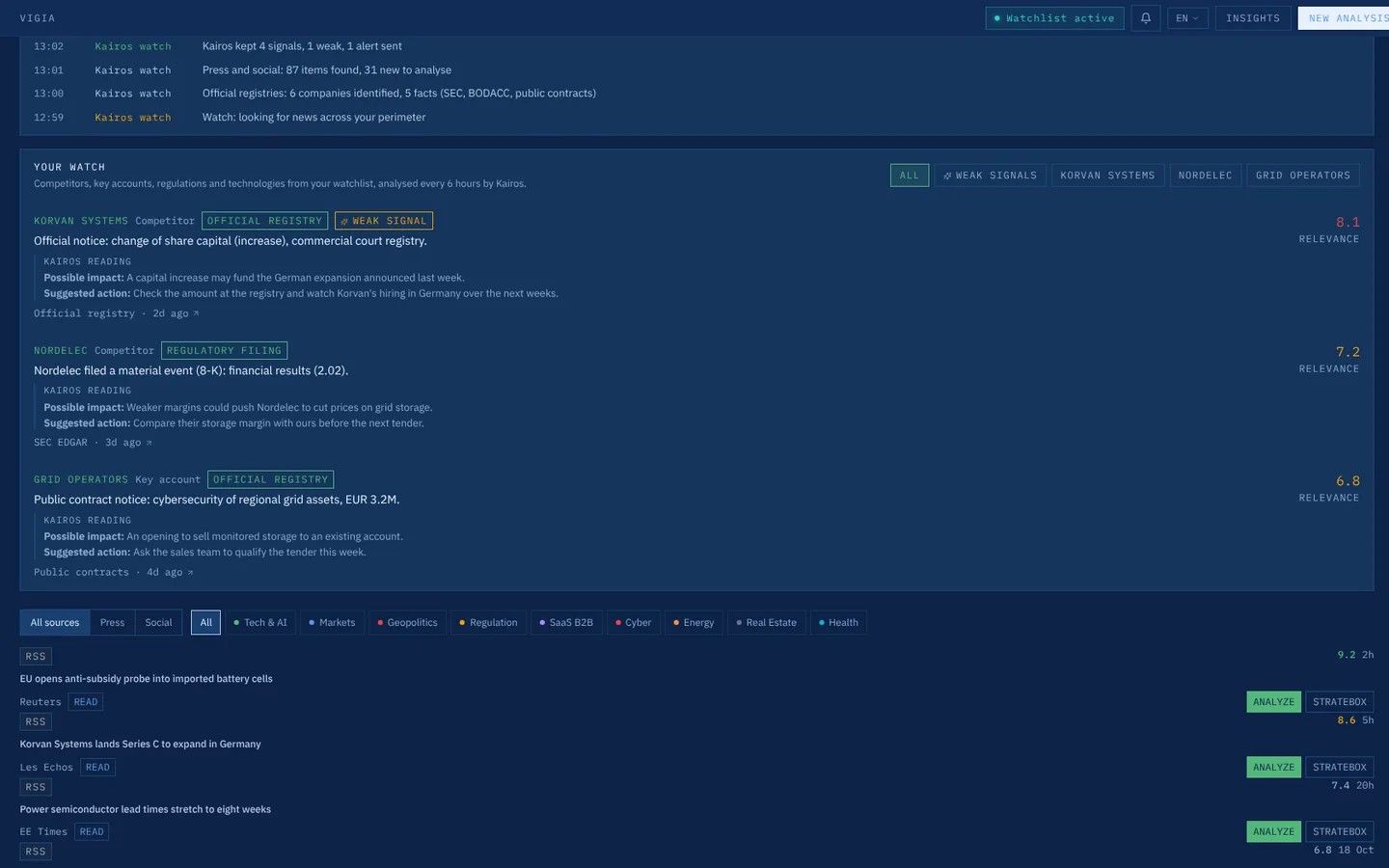
In this screenshot of the app, three alerts concern two fictional competitors and a key account: a capital increase published in the registry, a regulatory filing on financial results and a public contract notice. Each one shows its source, the Kairos reading, a suggested action and a relevance score.
What InekIA does not do
Better to know before choosing a tool.
- No non-public information
- InekIA works from public and official sources. A move that leaves no published trace will not show up, and no confidential competitor data is sought.
- No decisions on your behalf
- The Kairos reading is shown as an interpretation, separate from the fact. The suggested action is a proposal, yours to keep or drop.
- No monitoring without a scope
- Sorting is only as good as the watchlist. A vague scope gives vague alerts: the first step of the method stays yours.
Frequently asked questions
What is the difference between competitive intelligence and market intelligence?
Market intelligence looks at the market as a whole: demand, segments, trends, regulation. Competitive intelligence focuses on the companies you compete with and what they do. The two overlap, and both sit under strategic intelligence, alongside technology, regulatory and geopolitical monitoring.
Is competitive intelligence legal?
Yes, as long as it relies on information that can be accessed lawfully: the press, official publications, registries, company websites and communications. Obtaining confidential information by unfair means is a different matter, and trade secret law applies to it.
How many competitors should you track?
Fewer than you think. Start with the direct competitors you meet in tenders and lost deals, add the entrants that concern you, then widen the scope once the routine works. A short list that is followed beats a long one nobody reads.
How do you choose competitive intelligence software?
Check five things: the types of sources covered, official ones included; how well it sorts for your context; traceability, with every fact pointing to its source; how it moves from monitoring to analysis and decisions; and how easily the team can share it. Test it on your own competitors before you decide.
How quickly is competitive intelligence up and running with InekIA?
You list your competitors and priority topics; monitoring starts right away and briefs arrive continuously. The trial lasts 14 days, free, with no credit card.
Can you trust AI-assisted competitive intelligence?
Only if you can check it. In InekIA, every fact points to its source, the reading is shown separately, and a dedicated agent checks the citations in analyses. Kairos, the analysis engine, coordinates several language models chosen for each task, rather than relying on a single one.
Further reading
- InsightsCompetitive intelligence best practices for executives
- InsightsCompetitive intelligence market 2025: AI, regulation and strategic shifts
- InsightsFrench B2B SaaS competitive mapping: segment by segment
- InsightsDefensive economic intelligence: protecting strategic assets
- ExamplesReal reports produced by InekIA, dated and sourced
- UsesThree ways to use InekIA